
Back in October last year, North Tyneside Council announced that it was abandoning long-held plans to create a (relatively) safe cycle route between North Shields town centre and John Spence School.
The Chronicle reported that “Plans for a cycle lane in Preston Road, North Shields, have been dropped following a council review and local feedback.” According to a council officer quoted in the newspaper, “the Council has decided it is not possible to deliver a high-quality scheme that would meet the needs of residents and road users along the proposed route. The other key thing residents raised was about safety, concerns that have been echoed by local ward councillors.”
We had our own concerns about this decision and wanted to know:
- How the council defined “the community directly impacted” and what forms of engagement were undertaken, with whom and with what results, both in 2024 and in earlier rounds of consultation in 2021;
- How the council sought to engage with the hundreds of child and teenage cyclists who use the route to and from school (whether John Spence, Marden High, St Thomas More, or any of the nearby primary schools) or directly with the leadership team at John Spence School;
- How the decision to abandon the cycle path plans was taken, and by whom;
- How the plans developed to reflect council efforts to find a workable solution;
- If the council requested design advice from national experts at Active Travel England.
We submitted a Freedom of Information request in early November and – four months later (note: FOI requests should be responded to within 20 working days) – we’ve just received a reply.
In short, it seems the council abandoned the plans on the basis of 28 responses to a letter-drop consultation and concerns raised with (the local Tory) councillors, arguing that the demands of these residents and road users could not be reconciled with the design issues, on which the council seemed to seek no further design advice from regional or national experts.
We’ll highlight some of the key responses here:
On engagement, the council claim there is no formal definition of “the community directly impacted” but that “broadly this means residents living along or in close proximity to the route”. In Dec 2023/Jan 2024, letters were hand-delivered to addresses in these areas:
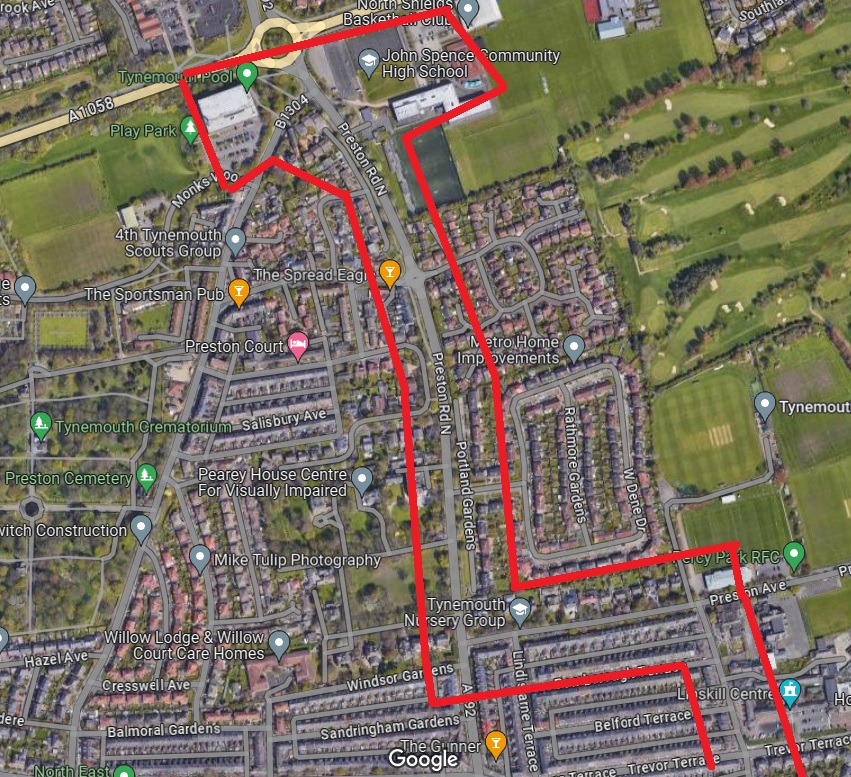
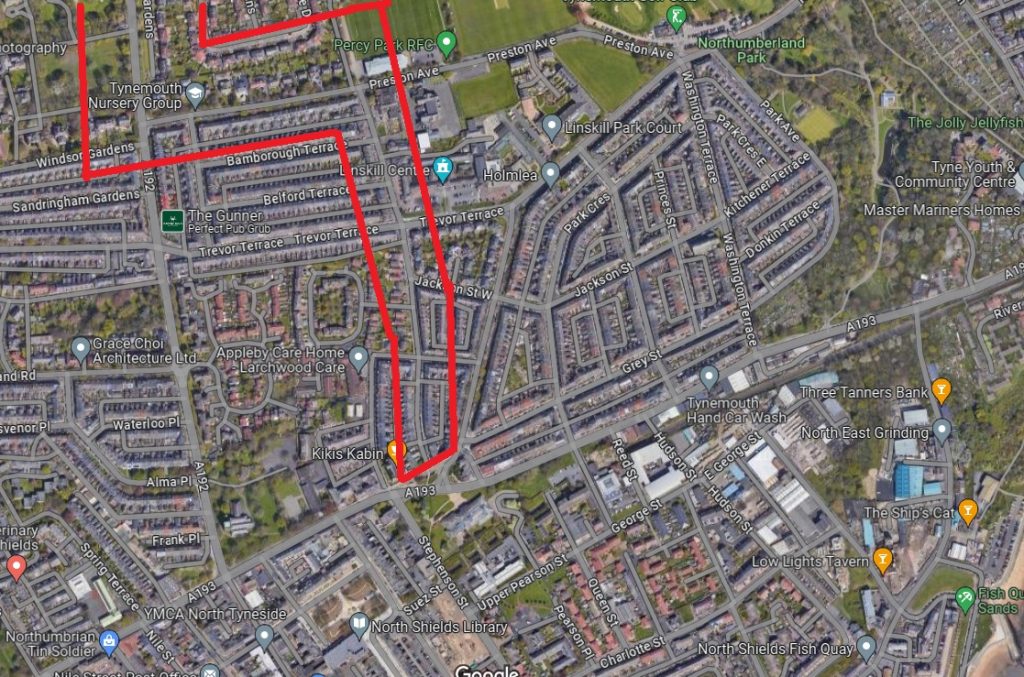
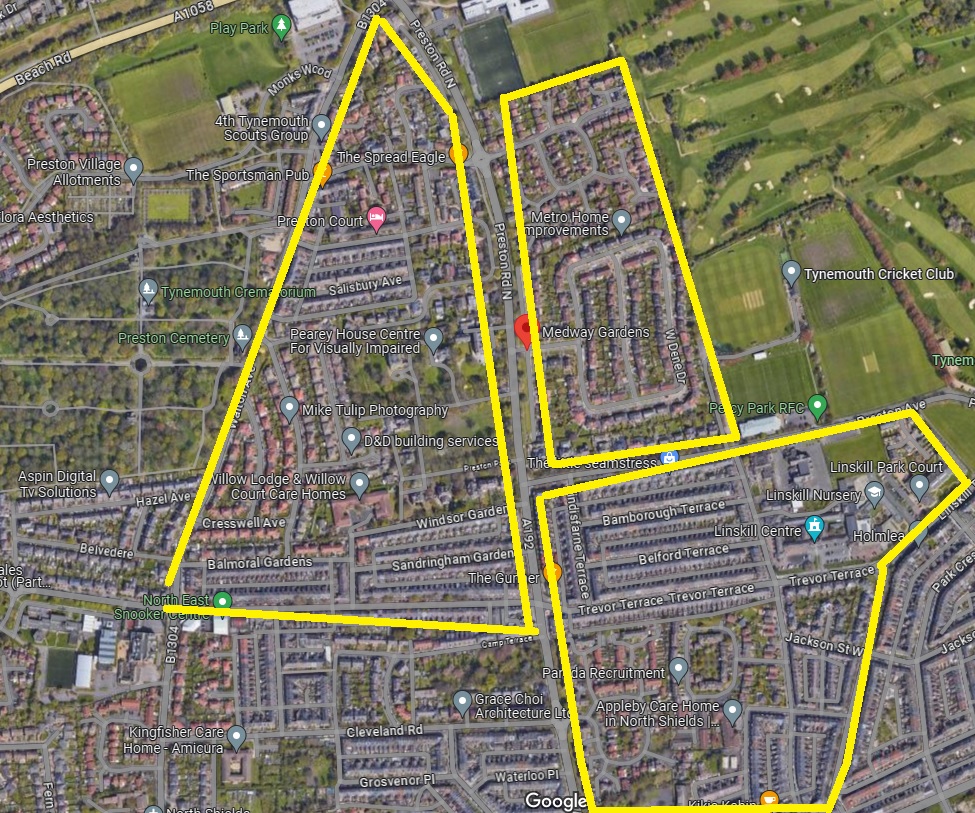
These maps reflect the routes various incarnations of the plans were designed to take, but fail to recognise where those who might opt to cycle along an improved Preston Road may be coming from or going to. In this take, “directly impacted” seems to mean those local “residents and road users” who might wish to drive along the roads to be redesigned – and therefore perhaps see themselves as negatively impacted – not those who might use the planned cycle paths. So, it seems there was no attempt to consult with anyone living in and around North Shields town centre or on Preston Grange whose routes around the borough – to schools, to jobs, to the shops, to the pool, etc. – might be positively transformed by the construction of a safe cycle route.
In response to query about focused engagement with under 18s who might use the route to and from school, the council replied: “No specific engagement exercises were carried out with this age group but schools were included in the consultation letter drop.” Their engagement with any of the schools, including John Spence Community High School, barely seems to have extended beyond this, with the head apparently not finding about the abandonment of the plans directly from council officers.
Whatever its focus, the council received just 28 responses to this 2023/24 consultation – but has no record of where these 28 respondents live, nor anything else about their demographics (age, gender, family status etc.).
The council also implies that this hand-delivered letter was the only form of consultation undertaken. Yet, in the article in The Chronicle, the council claims to be “a council that listens to our residents” and that it engaged “with families and businesses in the area”; Tory Councillor Liam Bones claims, moreover, that “residents were overwhelmingly against the unworkable proposals for a cycle path on Preston Road north”.
With 28 responses to what they claim was the only consultation exercise, is it really possible for either the council or Cllr Bones to suggest they know what local residents really want?
We also asked the council for a “summary of the responses to 2021 online consultation conducted via Placechangers to the plans for Preston Road, and documents outlining North Tyneside Council’s response to this consultation”. This request was refused, on the basis that “the A192 development was not included in the Placechangers consultation”.
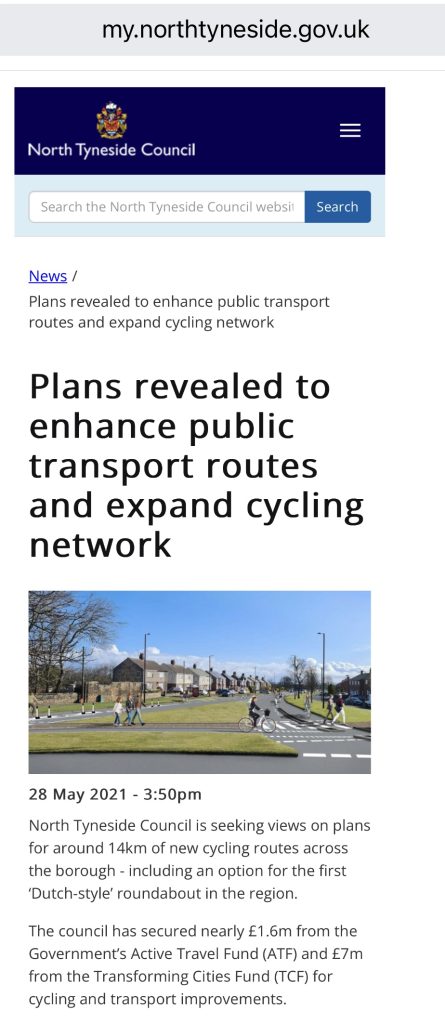
Yet it was, without doubt, and the council’s announcement of that consultation, published on 28th May 2021 and still, as we write, available online, confirms this. We wrote a blog about the plans in June 2021, in which you can see screenshots of the planned route from the Placechangers online consultation portal. We also corresponded with and had a series of online meetings with the deputy mayor, the then cabinet member for transport and environment, and then North Tyneside Highway Network Manager in early 2022, where updates to the plans were shared, as well as hopes that construction would begin on a revised plan in spring/summer 2022. Has the council simply forgotten this, or are they not keen to share the older consultation results with us?
On the taking of the decision, the council noted: “These matters were considered by cabinet members at private briefing meetings held with officers and decisions taken accordingly”. They shared a redacted record of the meeting where it was noted that:
“A series of consultation activities were held to seek resident feedback and designs have been improved to reflect this. However, following a final design review it became apparent that the design solution would not satisfy the requirements of LTN/120 (national design guidance). Whilst there is scope to depart from the guidance, in this instance it was thought that this would tip the balance from a quality / functionality standpoint, and we could end up with a scheme that meets none of the requirements of the various user groups or local residents who live along the route. As such, the scheme has been withdrawn on the grounds that a compliant design cannot be retrofitted into the existing highway in a manner which fully addresses safety and functionality concerns.”
The meeting notes confirm that “This matter has been discussed with the Director of Regeneration and Economic Development, the Deputy Mayor and the Cabinet Member for Environment who are supportive of the proposal.”
Whilst we shared many of the concerns about the nature of the design and, particularly, safety issues at junctions, the council confirms later in its FOI response that it did not seek help and/or advice from Active Travel England on adjusting plans to meet the demands of residents and road users. Whilst design support from ATE is not guaranteed, it seems the council did not even ask for any support, nor indeed, as far as we can tell, from regional officers at the North East Combined Authority.
All of this also suggests that other councillors – including nine local ward councillors (and Preston Road lies on the boundary between 3 wards: Preston with Preston Grange, North Shields, and Tynemouth) – were in the dark over this decision, notwithstanding the claim from the council in The Chronicle that residents’ concerns were “been echoed by local ward councillors”.
The implication that other councillors were left in the dark is reinforced by the fact that the council’s response to our request for copies of “all versions of the Preston Road scheme plans produced between May 2021 and October 2024” includes no updates or revisions after April 2024, a full five months before the decision was apparently taken to abandon the route. There appears to be no record of any additional design work during this period to try to resolve issues identified; it is not clear what the regularly-referenced “design review” was if no alternative plans were developed after April 2024, and no advice was taken from regional or national experts.
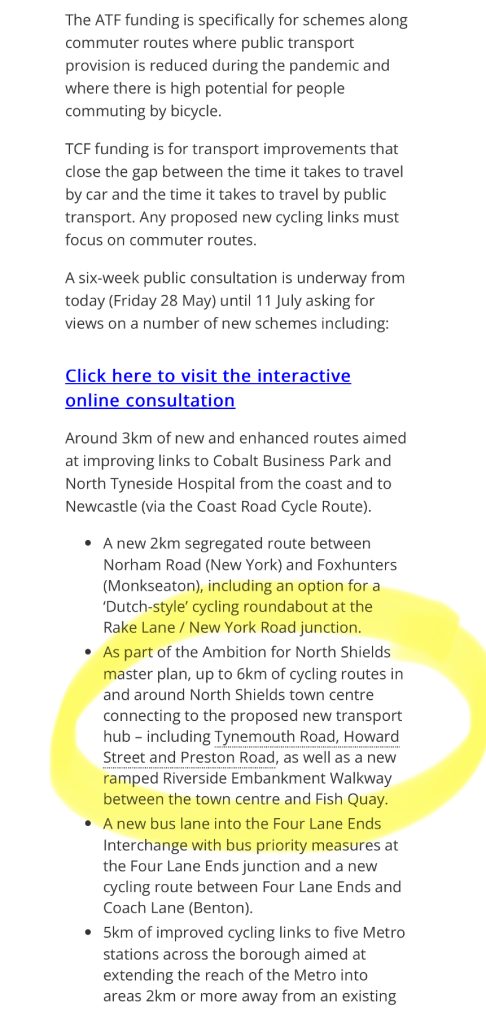
What is certain is that, despite three and a half years of planning, the Preston Road cycle path, which, the council itself suggested, would “provide a safe link for cyclists, including schoolchildren, between the town centre and A1058 Coast Road”, whilst also tying “into wider regeneration plans for North Shields, and support[ing] the local authority’s ambition to work towards the borough being carbon net-zero by 2030”, has been abandoned. Those who already cycle along Preston Road will have to continue to choose between dodging drivers or dodging pedestrians, as they make their way to or from school, Tynemouth pool, North Shields town centre, and elsewhere. The hundreds of others who might have been enabled to cycle by the provision of a safe route, reducing the number of cars on these everyday journeys and easing congestion and air pollution, will have to wait.
Last week saw the announcement of £9.5 million of funds from Active Travel England coming to the north east “to help join up cycle lanes and footpaths across the region”. Surely this route, connecting North Shields town centre to schools, residential communities and the existing the Beach Road cycle path to and from the coast, would be an ideal candidate for investment? We urge the council to think again and commit to creating safe walking and cycling infrastructure here.